Samples for the scientific study of unusual inner-shell electron states
Samples comprising previously unknown inner-shell electron configuration are available for rent or purchase.
Published on March 18, 2026 by Fenno-Aurum
thorium chain inner-shell electrons x-ray spectroscopy scientific analysis
2 min READ
Up to now, inner-shell electrons were thought to be passive ingredients of any material, with immutable electron configuration. Chemistry controls the configuration and bonds of outer-most electrons only. Unexpectedly, we synthesized materials with altered inner-shell configuration, demonstrating control over the inner-most electron states. These surprising results extend the scope of chemistry: instead of working with valence shell electrons only, future chemists might be working with inner-shell electrons as well.
Our sample materials comprise thorium, and its natural decay provides the excitation of inner-shell electrons. These samples can be therefore conveniently investigated by passive x-ray spectroscopy methods, which reveal altered inner-shell electron states.
Thorium and radium isotopes are at the beginning of the thorium decay chain. In ordinary thorium-comprising materials, the radium L-line peaks have about half the amplitude of the thorium L-line peaks. This ratio remains constant as long as the inner-shell electron environment remains the same.
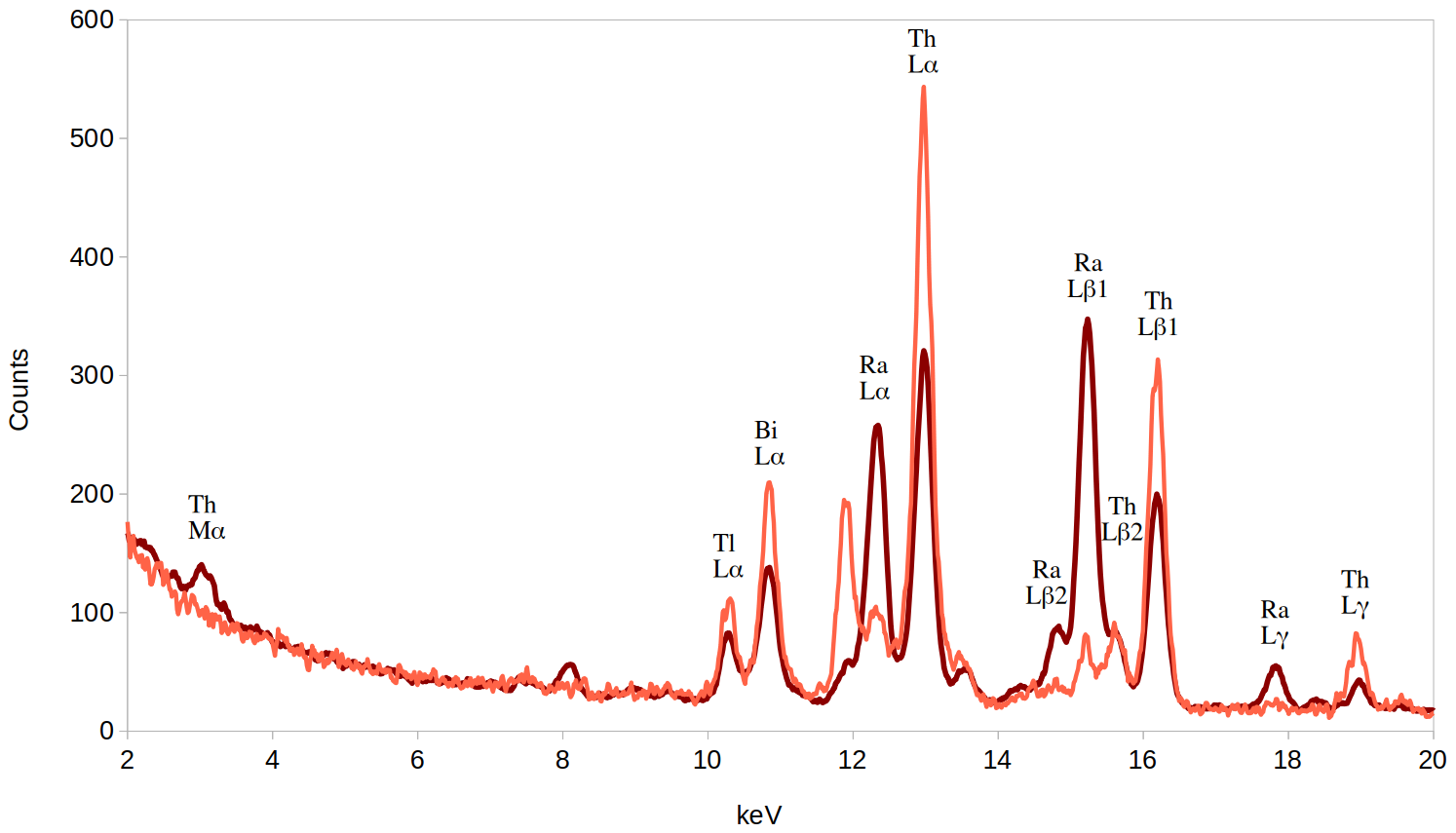
The illustration shows the passively measured x-ray spectra of two thorium-comprising samples; these spectra reveal two very different inner-shell electron configurations. These spectra are normalized to the same decay activity - represented by the same baseline signal amplitude. All thorium decay chain peaks are labelled. The unlabelled 13.5 keV peak is emitted by the nucleus upon the decay of Ra-228 isotope. We note the overlap between the bismuth L-beta and thorium L-alpha peaks. To get the true thorium L-alpha peak height, approximately the bismuth L-alpha peak height must be subtracted from the tall 13 keV peak.
In one spectrum, the radium peaks are taller than the thorium peaks: this is very different from the ordinary thorium decay chain spectrum where the radium peaks are half as tall as the thorium peaks. On the other hand, the thorium M-alpha peak becomes remarkably strong in this material.
In the other spectrum, the radium peaks are almost absent: this is very different from the ordinary thorium decay chain spectrum where the radium peaks are half as tall as the thorium peaks.
The contrast between these two spectra is particularly striking, and demonstrates altered inner-shell electron states. Moreover, these spectra remain stable over relatively long time period, i.e. as far as we could observe. The two materials producing these spectra have been synthesized from the same ingredients, and have the same chemical composition.
Our interesting discovery of previously unknown inner-shell electron states poses an interesting challenge for scientific explanation. We therefore make the samples producing these spectra available for scientific study, along with a reference sample that also has the same chemical composition.
Interested scientists may rent or purchase these sample materials for scientific study. Contact us for further details.
We also offer our proportional x-ray counter instrument, which is an excellent tool for passive x-ray spectroscopy. In the context of investigating inner-shell electron states, we found the proportional x-ray counter to be a complementary instrument to silicon-based x-ray spectrometers.